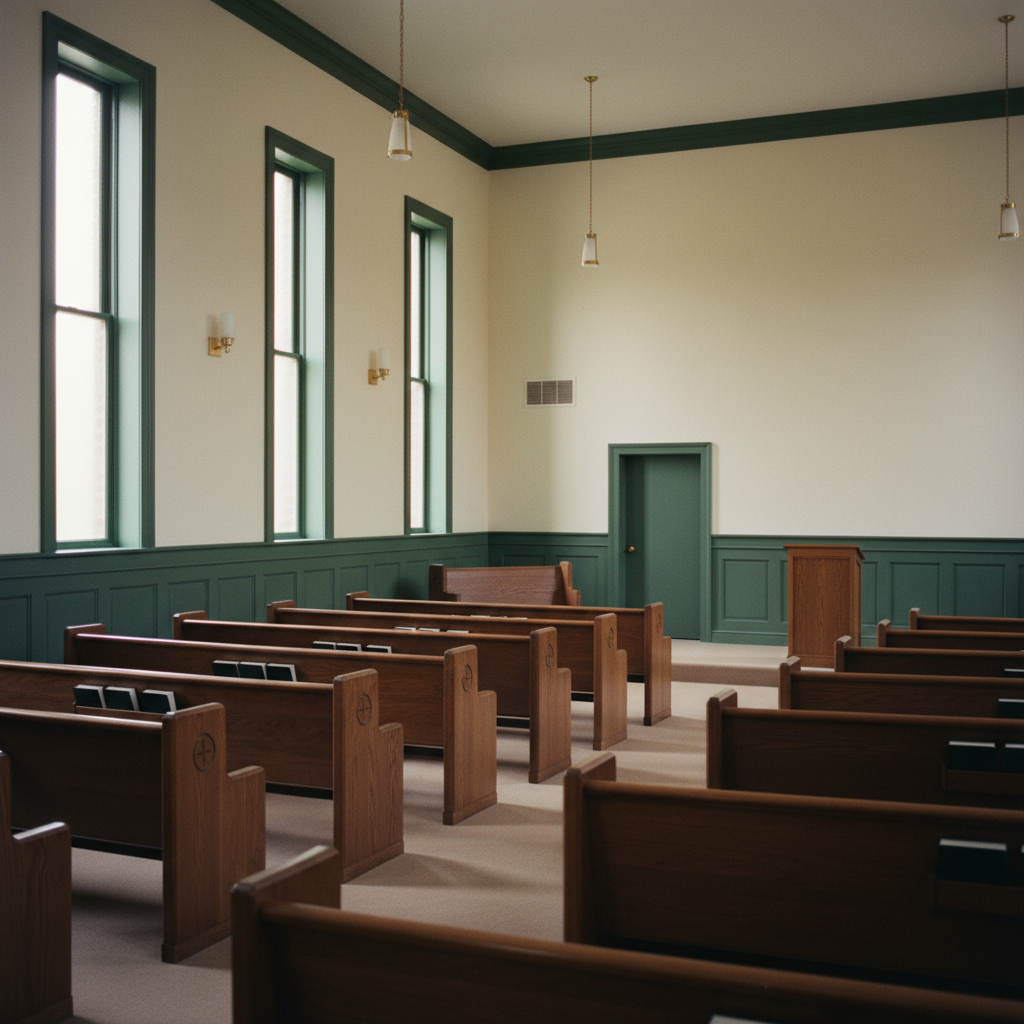
A funeral home is not a service. It is a vessel. The vessel is what holds the grief while the family holds the memory.
First generation · Theodore Westbrook · 1928
Theodore Westbrook opened the chapel on Euclid Avenue on the third of March, 1928. He had been working as an apprentice at the McNamara funeral home in the Flats since 1922 — for the better part of those six years he had served as the night man, the one who answered the door at three in the morning. The McNamara family let him go on his own with a handwritten letter of recommendation, which his son Robert later framed; it now hangs in the chapel office.
The Cleveland of 1928 was a mosaic of immigrant neighborhoods. The German Lutherans of Tremont. The Irish and Italian Catholics of Little Italy and Collinwood. The Polish Catholics of Slavic Village. The first wave of Jewish families had been settling around Anshe Chesed since the 1880s. Theodore’s decision to open a multi-faith chapel — not a Catholic firm, not a Lutheran firm, but a chapel that would learn each family’s rite — was unusual in 1928. It was the decision the firm has been carried by for ninety-eight years.
Theodore’s wife Hannah ran the office. They had two sons, Robert and James. Theodore retired in 1958 and spent his last years writing a short manuscript called A Funeral Director’s Notebook, which Robert later edited but never published.
Second generation · Robert Westbrook · 1958
Robert Westbrook returned from the Pacific in 1946 and apprenticed under his father for twelve years before taking over the chapel in 1958. He was twenty-eight when he came home and forty when his father retired. His brother James had been killed in the Philippines in 1944; Robert was the only son left. He carried that.
Two things distinguished Robert’s tenure. First, he built the chapel’s deep relationship with the Cleveland Catholic Diocese in the postwar period — by 1968 Westbrook was the chapel of choice for half the East Side parishes. Second, he began the relationship with the Cleveland Jewish community that the chapel rests on today. Robert spent three years apprenticed to the chevra kadisha at Anshe Chesed Fairmount Temple — quietly, after his daytime work, three or four evenings a week, year after year. The relationship was built one taharah at a time.
Robert retired in 1986. He lived to ninety-three and was buried, at his request, in a plain pine casket — the same kind he had carried for fifty Jewish funerals himself.
Third generation · David Westbrook · 1986
David, Robert’s son, took over in 1986. He was thirty-one. He had earned his funeral director’s license at Cincinnati College of Mortuary Science in 1979 and apprenticed under his father for seven years.
David’s contribution was twofold. He extended the chapel’s practice to Cleveland’s historic Black-church community — the homegoing service — which had been served by smaller chapels on the East Side but had not had a deep partner among the older Cleveland firms. David built the chapel’s relationships with Antioch Baptist and Olivet Institutional in the late 1980s, and from there with the city’s broader AME, COGIC, and historic Baptist congregations.
David also professionalized the chapel’s operations — pricing transparency, the General Price List in plain English, a published GPL for every tradition, and a no-pressure pre-planning practice. The chapel has not charged a separate fee for a pre-planning conversation since 1991. David retired in 2014 and moved to Chautauqua, New York, where he reads philosophy and plays the piano.
Fourth generation · Dr. Marcus Westbrook · 2014
The current funeral director and managing partner. Marcus, David’s son, was forty when he took over. He had earned his funeral director’s license in 2008 (Cincinnati College of Mortuary Science, like his father) and a Master of Divinity from Yale Divinity School in 2011. He is the first of the Westbrook men to hold a theology degree; he is not ordained.
Marcus’s work has been to formalize the chapel’s multi-faith practice — to write down what his father and grandfather knew by heart, to train new staff in the four traditions, and to articulate the chapel’s position publicly. The Faith Traditions section of this website is his work, mostly written at the kitchen table over the winter of 2024 with his sister Anne, who serves as the chapel’s general manager and runs the office.
Marcus and Anne live within three miles of the chapel. Marcus and his wife Sarah have three children; Anne and her husband Jonas have two. The fifth generation, if there is one, has not yet been asked.
The chapel and Cleveland
The chapel has been in continuous operation at 1428 Euclid Avenue since 1928. The building was originally a two-story brick row house; Theodore added the chapel addition (the larger room at the rear) in 1934 during the Depression — “because the work continued,” he wrote in his Notebook. The chapel addition has been expanded twice, in 1962 and 1991, but the original 1928 facade on Euclid Avenue remains exactly as it was.
We have served families through the influenza waves of 1918 and 2020 (the chapel was still Theodore’s in 1918 — though officially McNamara’s — and the 2020 winter was the most demanding stretch in the chapel’s history). We have served families through the Cleveland steel-mill closures of the 1970s and 1980s. We have served families through the East Side cemeteries that closed and the East Side cemeteries that reopened. We have served families on every block from Lakeshore to Lee Road.
The chapel does not advertise. It has not advertised since 1934. We are here because our clergy partners send their families to us, and because their families send their friends. We hope you will find us the same way.
The firm is a vessel. The vessel is what holds the grief while the family holds the memory.
Speak with a Westbrook Read about the traditions we serve