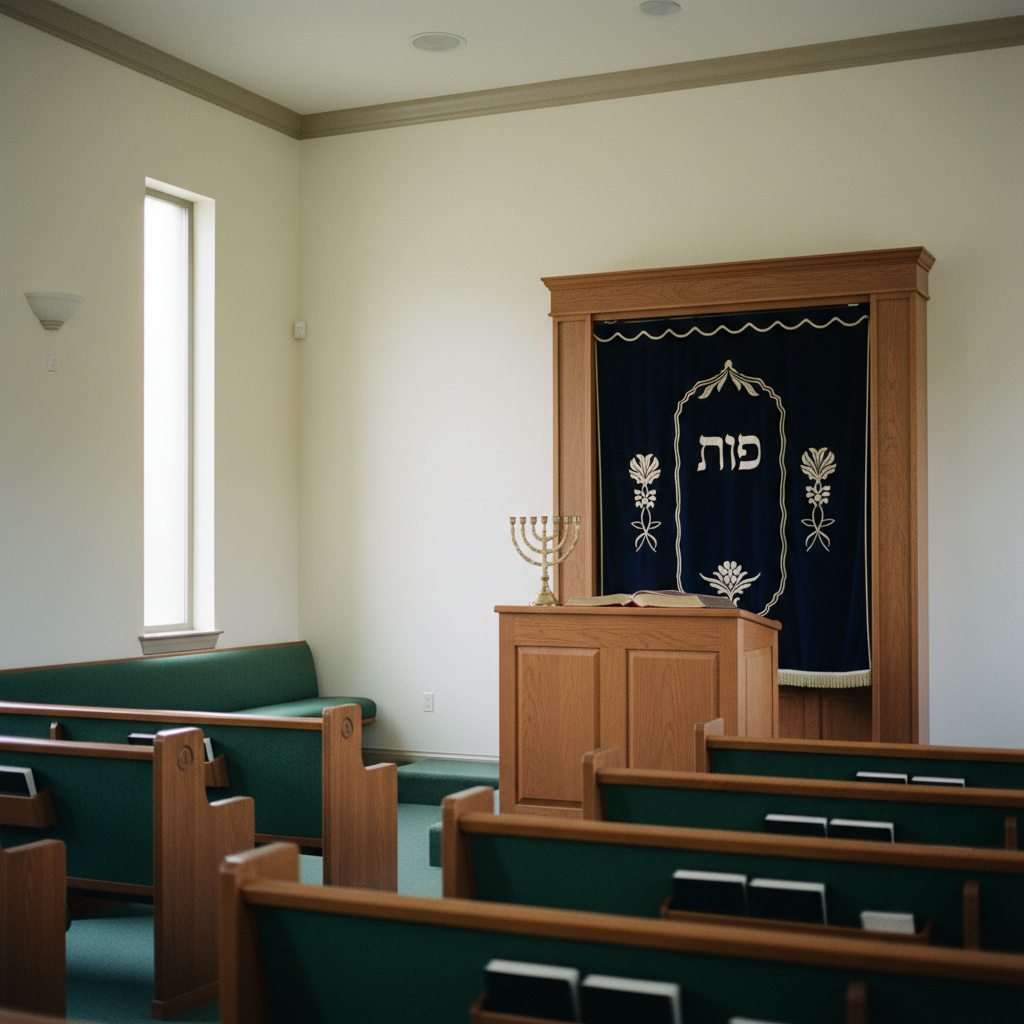
Westbrook Memorial Chapel began serving Cleveland’s Jewish community in the late 1940s. Theodore’s son Robert, returning from the war, came home with the conviction that the city’s Jewish families deserved a funeral home that understood the rituals — and that this was not the moment in history when those rituals could be allowed to fade. He spent his first three years apprenticed to the chevra kadisha at Anshe Chesed Fairmount Temple. The relationships he built then are the relationships our chapel rests on now.
What happens in the first hour
The phone rings — at any hour. A Westbrook answers. We send a vehicle. We notify the chevra kadisha of the rabbi the family names — or, if no rabbi is named, we ask the family which congregation they belong to, and we make the call ourselves. We notify the synagogue’s office to begin the shiva minyan list.
From the moment of death, the body is treated with כבוד המת (kavod ha-met, honor for the deceased). No photographs are taken. The body is covered. The eyes are closed by family or by us. We do not embalm.
The chevra kadisha and the taharah
The חברה קדישא (chevra kadisha) — the burial society — performs the טהרה (taharah), the ritual washing and dressing of the body, in our preparation room. The chevra kadisha members are trained volunteers from the Cleveland Jewish community. We have served as the chapel where the chevra kadisha does its work for seventy years.
After taharah, the deceased is dressed in תכריכים (tachrichim) — the simple white linen burial shroud, made without pockets, signifying the principle that all are equal in death. We stock tachrichim; the family is not asked to provide them.
Shemira — the watching
From the moment of death until burial, the body is not left alone. שומרים (shomrim, watchers) sit with the deceased, often reading psalms. We coordinate a roster of shomrim from the chevra kadisha, or we accommodate family members who wish to fulfill this mitzvah themselves. We provide the room, the chair, and the Tehillim (Psalms).
The aron — a simple pine casket
Jewish law calls for a simple wooden casket, traditionally pine, without metal hardware. We carry a range of plain wooden arons from $980 to $2,400. We do not steer families to more expensive caskets. We do not steer families to anything.
The halvayah — funeral and burial within 24 hours where possible
The הלוויה (halvayah) — the funeral and burial — happens within twenty-four hours where possible. We coordinate the chapel service, the procession, and the burial itself. We work with Cleveland’s Jewish cemeteries: Mayfield Cemetery, Hillcrest, Bet Olam, and the older cemeteries on the East Side. Family members shovel the first earth onto the aron — a difficult and intentional act. The kaddish is said.
The shiva — seven days at home
Beginning after burial, the family sits shiva for seven days. We coordinate the shiva minyan (the gathering of ten for the evening prayers) — we prepare a list of available minyan participants and provide it to the synagogue. We supply shiva chairs (low stools) to the home, mirror coverings, and a ner shiva (the seven-day candle). We coordinate meals with the synagogue’s bereavement committee and any community-provided meal calendars. Our role is to make sure the family is not running errands during shiva.
The unveiling — eleven months later
The stone-setting at the grave eleven months after burial is the second goodbye. We coordinate the date with the cemetery, contract the monument maker if the family does not have a preferred one, and host the brief unveiling service. Many families return to the chapel afterwards for a simple gathering.
What is not done
- No embalming.
- In accordance with Jewish law. The body is washed (taharah), not embalmed.
- No flowers.
- Jewish funerals do not include flowers. Donations to the synagogue, the Cleveland Jewish Federation, or a charity of the family’s choosing are the convention. We will list this on the obituary if the family wishes.
- No cremation by default.
- Traditional Jewish law forbids cremation. If a family chooses it, we will coordinate it; we will not pressure either direction.
- No open casket.
- Jewish funerals are closed-casket. Family may have a brief private viewing before taharah, if requested.
The synagogues we work with most closely
Anshe Chesed Fairmount Temple. Park Synagogue. B’nai Jeshurun. Tifereth Israel. Suburban Temple-Kol Ami. Beth Israel — The West Temple. The Green Road Synagogue (Modern Orthodox). Heights Jewish Center. Young Israel of Cleveland (Modern Orthodox). We serve Conservative, Reform, Reconstructionist, and Modern Orthodox families equally.
Speak with us about a halvayah
If you are calling because a death has just occurred, dial (216) 555-0142. We will be on the way within the hour.